Skip to main content

|
Listen to Todays Featured Blog ????
Getting your Trinity Audio player ready...
|
Small business SEO is the cornerstone of digital marketing success for any small business trying to improve their online presence. By leveraging SEO, small businesses can see significant improvements in website rankings, increased web traffic, and ultimately, more customers.
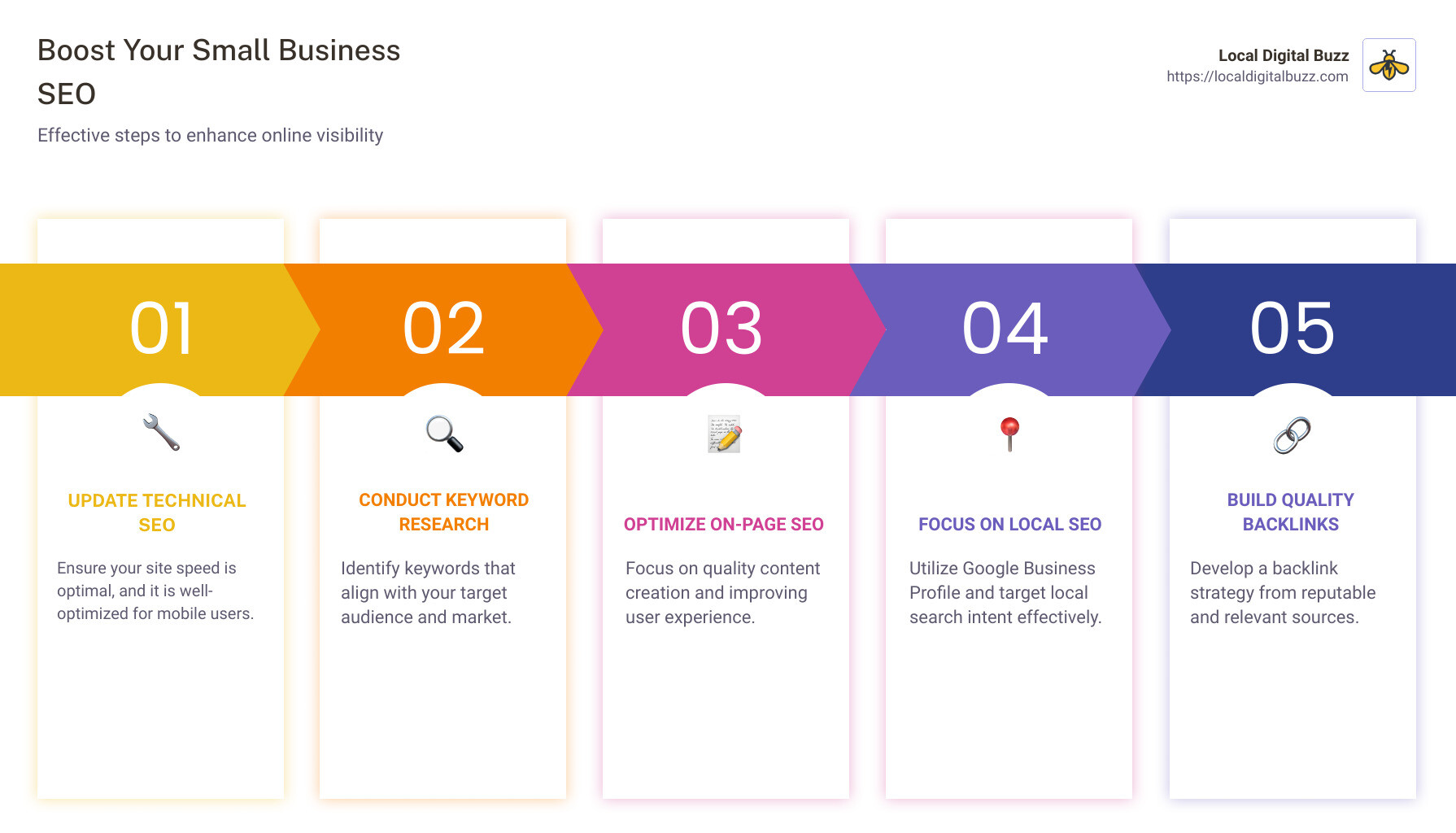
If you’re looking to quickly improve your website ranking, here are five changes you can make:
- Ensure technical SEO is up-to-date.
- Conduct thorough keyword research.
- Optimize on-page content.
- Focus on local SEO practices.
- Build quality backlinks from reputable sources.
These steps are proven to boost a small business’s online visibility and attract more potential customers.
As a digital marketing expert and former United States Marine, I’m Joshua Fleming, and I’ve dedicated my career to helping businesses thrive through small business SEO. My experience includes working with both local businesses and high-profile clients to craft effective SEO strategies that drive results.
Now, let’s dive deeper into how you can harness the power of SEO to transform your business.
Optimize Your Website’s Technical SEO
When it comes to small business SEO, technical optimization is a crucial step. It lays the foundation for everything else. Let’s break down how to optimize your website’s technical SEO.
Site Speed
Site speed is a critical factor. A slow website can frustrate users and increase your bounce rate. Did you know that many visitors will leave your site if it takes more than a few seconds to load? This can hurt your search engine ranking.
Here are three simple ways to boost your site speed:
- Check for viruses: Viruses can slow down your site. Regularly scan your website to keep it clean.
- Compress large files: Reduce the size of images and videos. This can make your pages load faster.
- Upgrade your hosting plan: If your website is growing, you might need more bandwidth. An upgraded hosting plan can help.
Mobile Optimization
With more people using smartphones to browse the web, mobile optimization is a must. In 2023, 76% of people who searched for something nearby on their phones visited a business within a day. If your website isn’t mobile-friendly, you could miss out on local customers.
Make sure your site looks great and works smoothly on all devices. Use a responsive design that adapts to different screen sizes. Test your website on various devices to ensure a seamless user experience.
Technical Audit
A technical audit is like a health check for your website. It helps you identify and fix issues that could be hurting your SEO.
What to check in a technical audit:
- Page titles and meta descriptions: Ensure they’re unique and relevant.
- Page speed: Use tools like Google PageSpeed Insights to test your site.
- Broken links and redirect chains: Fix or remove any broken links and unnecessary redirects.
- Schema markup: Implement structured data to help search engines understand your content better.
By addressing these areas, you can improve your website’s technical performance and boost your search engine ranking.
With a solid technical foundation, you’re ready to move on to the next step: conducting thorough keyword research.
Conduct Keyword Research
Keyword research is the backbone of small business SEO. It’s about figuring out what your potential customers are searching for online. Once you know this, you can tailor your content to meet their needs and improve your keyword ranking.
Understanding Keyword Ranking
Keyword ranking is simply where your website appears in search engine results for specific keywords. The higher your rank, the more likely people are to visit your site. But how do you choose the right keywords?
Using Keyword Research Tools
There are several tools available to help you find the best keywords for your business. Tools like Google Keyword Planner, SEMRush, and Ahrefs are popular choices. They show you how often certain words are searched and how much competition there is for those words.
Here’s a quick look at how to use these tools:
- Identify relevant keywords: Enter words related to your business to see suggestions. For example, if you own a pet store, you might enter “dog food” or “pet grooming.”
- Analyze search volume: Check how many people are searching for each keyword. Higher search volumes mean more potential traffic.
- Evaluate competition: Look at how many other sites are targeting the same keywords. Less competition can make it easier to rank higher.
Know Your Target Audience
Your target audience is the group of people most likely to buy your products or services. When you know who they are, you can choose keywords that match their interests and needs.
- Create customer personas: Think about your ideal customers. What are their ages, interests, and problems they need solving?
- Use specific keywords: Instead of broad terms like “shoes,” use more specific ones like “women’s running shoes” or “kids’ hiking boots.”
By focusing on the right keywords, you can attract the right audience and improve your chances of converting visitors into customers.
By now, you’ve got a list of keywords that connect with your audience. Next, we’ll explore how to improve on-page SEO to make the most of these keywords.
Improve On-Page SEO
Once you’ve nailed down your keywords, it’s time to focus on on-page SEO. This involves optimizing various elements on your website to improve its ranking in search results. Let’s explore three key areas: content creation, internal links, and user experience.
Content Creation
Creating high-quality content is essential for effective small business SEO. Your content should be relevant, informative, and engaging. Here’s how to do it:
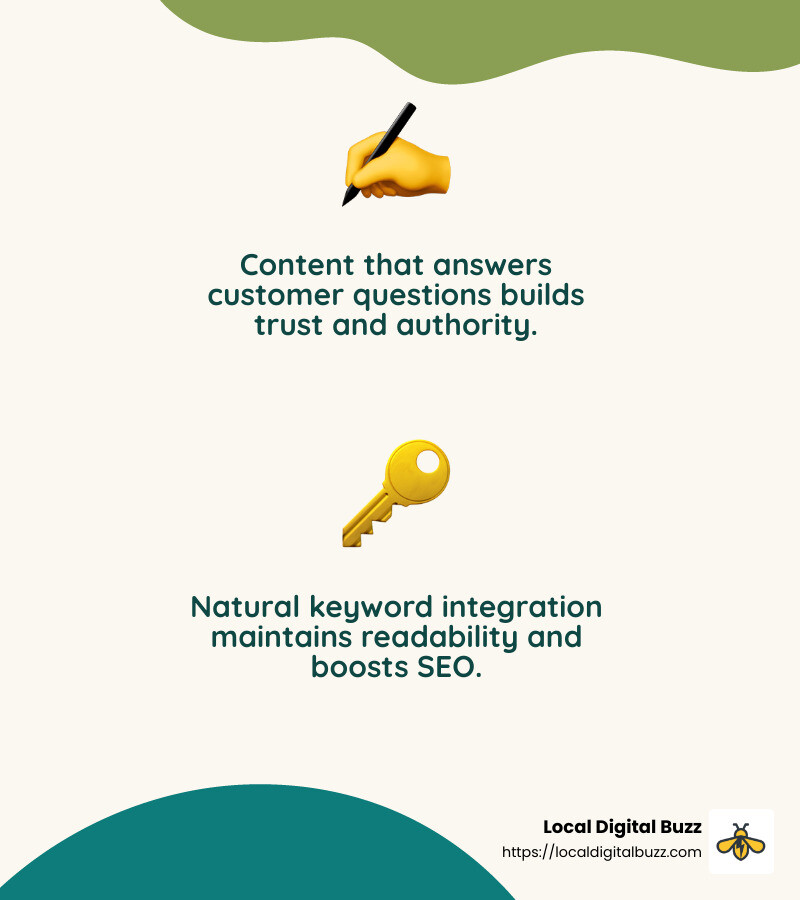
- Focus on your audience: Write content that answers your customers’ questions or solves their problems. This builds trust and positions your business as an authority.
- Use keywords naturally: Incorporate your chosen keywords into your content, but avoid keyword stuffing. Keywords should fit naturally within the text to maintain readability.
- Visual appeal: Break up text with images, videos, or infographics to make your content more engaging. For example, a hair salon might include before-and-after photos of hairstyles.
Internal Links
Internal linking is another crucial aspect of on-page SEO. It involves linking one page of your website to another. This helps search engines understand the structure of your site and keeps visitors engaged longer.
- Link to relevant pages: Ensure that your links are relevant and add value. For example, if you mention “hair dyeing” on your homepage, link to a detailed page about your hair dyeing services.
- Use descriptive anchor text: The clickable text of your link should be descriptive and relevant to the target page. Instead of “click here,” use “learn more about hair dyeing.”
- Create a logical structure: Organize your website so that related content is connected through internal links. This improves navigation and helps users find the information they need.
User Experience
User experience (UX) is all about making your website easy and enjoyable to use. A positive UX can lead to higher engagement and better search rankings.
- Mobile optimization: Ensure your website is responsive and looks good on all devices. With 64% of searches done on mobile, a mobile-friendly site is crucial.
- Fast loading times: Slow websites frustrate users and can lead to higher bounce rates. Optimize images and reduce unnecessary scripts to improve loading times.
- Clear navigation: Make sure your site is easy to steer. Use clear labels and a simple menu structure so visitors can find what they’re looking for quickly.
By focusing on these on-page SEO strategies, you can improve your website’s visibility and provide a better experience for your users. Next, we’ll explore how to leverage local SEO to attract nearby customers.
Leverage Local SEO
Local SEO is a powerful tool for attracting customers in your area. By focusing on local search, you can ensure your business pops up when people nearby are searching for products or services like yours. Let’s explore how to make the most of local SEO.
Google Business Profile
Setting up a Google Business Profile is one of the simplest ways to improve your local SEO. It’s like a digital business card that appears right in search results and on Google Maps.
- Claim and verify your profile: Make sure your business is listed and that you’ve claimed it. This allows you to manage the information Google displays about your business.
- Keep information accurate: Ensure your name, address, and phone number (NAP) are consistent and accurate. This builds trust with both customers and search engines.
- Encourage reviews: Ask happy customers to leave positive reviews. This not only boosts your reputation but also signals to Google that your business is trustworthy.
Local Intent
Understanding and targeting local intent is key to capturing nearby customers. Local intent refers to searches where the user is looking for something specific to their location.
- Use location-based keywords: Incorporate location-specific terms into your content. For instance, a bakery in Austin might use “best cupcakes in Austin” as a keyword.
- Create local content: Write blog posts or create pages that focus on local events, news, or community activities. This shows you’re engaged with your community and helps you rank for local searches.
- Add location pages: If you have multiple locations, create a dedicated page for each one. Include details like address, contact info, and directions to help customers find you easily.
By focusing on local SEO, you can make your business more visible to people in your area. This can lead to increased foot traffic and sales. Next, let’s dive into how to build quality backlinks to further improve your search rankings.
Build Quality Backlinks
Building quality backlinks is crucial for improving your website’s authority and search engine rankings. Backlinks are like votes of confidence from other websites, telling search engines that your site is a reliable source of information. Here’s how to create a solid backlink strategy:
Backlink Strategy
A well-thought-out backlink strategy can significantly boost your site’s visibility.
- Identify reputable sources: Aim to get links from well-known and trusted websites. This can include industry blogs, news sites, or educational institutions.
- Create shareable content: High-quality, informative content is more likely to be shared and linked to by other sites. Consider writing guides, infographics, or case studies that provide real value to your audience.
- Engage with industry communities: Join forums or social media groups related to your industry. Share your expertise and link to your content when relevant.
Reputable Sources
Securing backlinks from reputable sources improves your site’s credibility.
- Submit to directories: Ensure your business is listed in reputable directories such as Google Business Profile, Bing Places, and Yelp for Business. These platforms not only provide backlinks but also increase your visibility.
- Network with local businesses: Collaborate with other local companies to exchange links. This can be mutually beneficial, especially if you operate in complementary industries.
- Guest blogging: Write guest posts for popular blogs in your niche. This not only builds backlinks but also positions you as an authority in your field.
Link Building
Effective link building requires patience and persistence.
- Monitor your backlinks: Use tools like Google Search Console to keep track of who is linking to your site. This helps ensure your backlinks are from quality sources.
- Reach out for links: Don’t hesitate to contact websites that you believe would benefit from linking to your content. A polite email explaining the value of your content can go a long way.
- Fix broken links: Identify broken links on your site and fix them promptly. Broken links can harm your SEO and user experience.
By focusing on building quality backlinks, you’ll improve your website’s authority and improve your search rankings. Next, we’ll tackle some frequently asked questions about small business SEO to clear up any lingering doubts.
Frequently Asked Questions about Small Business SEO
Does SEO really work for small businesses?
Absolutely! SEO is a powerful tool for small businesses looking to grow. According to recent data, 53.3% of all website traffic comes from organic searches. This means that when done right, SEO can drive significant traffic to your site without the need for costly ads.
By optimizing your website for search engines, you improve your chances of being found by potential customers. Plus, SEO is not just about ranking higher; it’s about providing value to your audience. High-quality, informative content can establish your business as an authority in your industry, attracting more visitors over time.
How much does SEO cost for a small business?
The cost of SEO services can vary widely depending on the scope of work and the agency or consultant you choose. On average, small businesses might spend anywhere from a few hundred to several thousand dollars per month on SEO.
Budget considerations are crucial. It’s important to find a balance between affordability and quality. Some agencies offer flat-rate packages, while others might charge hourly rates. It’s essential to discuss your goals and budget with potential SEO providers to find a plan that fits your needs. SEO is an investment that, when done correctly, can yield substantial returns in the form of increased traffic and sales.
What is the difference between small business SEO and local SEO?
While both are essential, small business SEO and local SEO focus on different aspects. Small business SEO aims to improve your website’s visibility on a broader scale, targeting a wider audience. It involves optimizing your site for relevant keywords, creating quality content, and building backlinks to boost overall search engine rankings.
On the other hand, local SEO is about enhancing your online presence within a specific geographic area. It’s crucial for businesses with a physical location or those serving a particular region. Local SEO strategies include optimizing your Google Business Profile, gathering online reviews, and ensuring your business information is consistent across online directories. In 2023, 76% of people who searched for something nearby visited a business within a day, highlighting the importance of local SEO for driving foot traffic and local engagement.
Understanding these differences helps tailor your strategy to meet your business goals effectively.
Conclusion
At Local Digital Buzz, we understand the unique challenges that small businesses face in the digital landscape. Our customized strategies are designed to help your business grow by enhancing your online presence and optimizing your website for search engines. We combine cutting-edge technology with a human touch to deliver results that matter.
Why choose us? Our all-in-one approach means you get comprehensive digital marketing, social media, and lead-generation services without long-term contracts. We focus on creating custom solutions that align with your business goals and budget. Whether it’s improving site speed, conducting keyword research, or building quality backlinks, our strategies are crafted to drive traffic and boost your search engine rankings.
Small business SEO is not a one-time task but a continuous process. It requires effort and patience, but the rewards are worth it. By investing in SEO, you’re investing in the future of your business. With our expertise, you can confidently steer the digital world and achieve sustainable growth.
Let us help you make your small business more visible and successful. Partner with Local Digital Buzz and see your business thrive!